
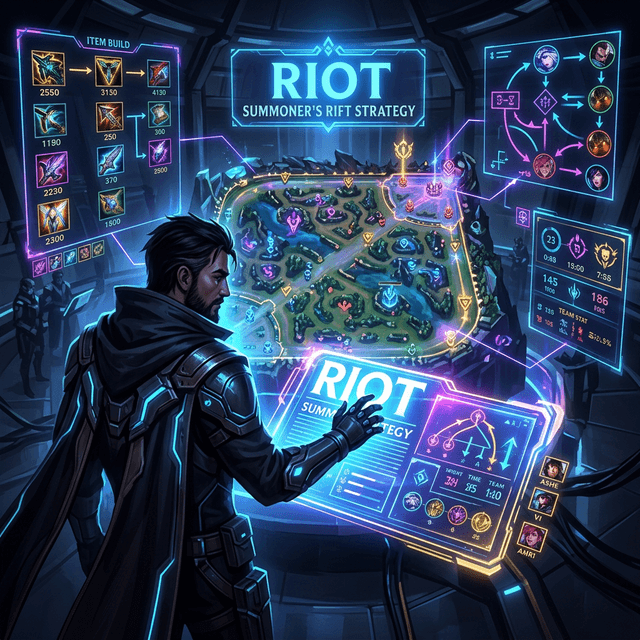
The Future of Wild Rift: AI Coaching and Dynamic Builds
What's up guys! If you've been grinding League of Legends: Wild Rift or PC LoL for a while, you know perfectly well that reaching the high ranks (we're talking Grandmaster or Sovereign) demands a level of focus and analysis that sometimes feels more like an office job than a game. The meta changes every two weeks, champions get surprise nerfs, and items are constantly updated.
For years, the way to improve was to watch hours and hours of streams, read crazy long patch notes, or pay a human coach to yell at you on Discord for missing farm at the 10-minute mark. But data analysis is revolutionizing how we play. Today we're going to talk about the tech that is changing the rules of the game: AI Coaching and Dynamic Builds.
It's a highly innovative angle that mixes old-school gaming with cutting-edge tech, and literally, it's the future of esports. Get comfortable because we are going to break down how AI is going to drag us out of Elo Hell.
1. The Average Player's Trap: The End of Static Builds
Raise your hand if you haven't gone to a website, searched for "Best Jinx build patch 7.0," copied the five items, the runes, and just started playing without thinking. We've all done it. The problem is that copying the server's Rank 1 build is the most common mistake keeping you from climbing.
Why? Because that Rank 1 player crafted that specific build for a specific match, against a specific enemy team comp, and with a specific gold lead. In Wild Rift, context is everything. If you rush an Infinity Edge as your first item just because the guide says so, but you're playing against three AD assassins who are stomping you, what you need is a Guardian Angel or armor boots, not just raw damage.
This is where AI-powered Dynamic Builds come in.
Instead of offering a static buy path, an AI analyzes the following factors in real-time (or on the loading screen):
- Your team comp vs. Enemy comp: Does the rival team have a lot of magic damage (AP) or physical damage (AD)? Do they have tanks with crazy health regen?
- Match economy: Are you winning your lane with gold to spare for expensive scaling items, or are you losing and need cheap items that give immediate stats to survive?
- Rune Synergy and Current Patches: The AI knows if an item got nerfed yesterday and is no longer mathematically efficient.
A smart app doesn't tell you "Always buy this." It tells you: "Bro, the enemy Zed has 3 kills at minute 5. Your survivability in team fights drops by 42% if you don't build Zhonya's Hourglass on your next base." That level of specificity wins games.
2. Real-Time Coaching: Your Digital Jiminy Cricket
Data analysis doesn't stop at the item shop. The true revolution is in real-time coaching. PC tools like Mobalytics, Blitz.gg, or iTero are already laying the groundwork for what will soon be an undeniable standard in mobile games too.
Imagine playing jungle. You're so focused on clearing your camps that you don't realize your Top laner is pushing the wave under the enemy tower, with no vision, and the rival jungler has been MIA for 45 seconds. A human coach would tell you to ping your Top to back off.
An AI Coach (using language models and computer vision or reading the game's API) sends you a visual or voice alert saying: "Warning: High probability of a gank in the Baron lane. The enemy jungler was last seen at their red buff 40 seconds ago. Rotate to counter or take a free Dragon."
This isn't sci-fi. The AI evaluates metrics that we humans usually forget due to the stress of the match:
- Wave Management: It warns you if you're losing gold by not shoving the wave before recalling.
- Farming Efficiency (CS/min): It measures your creep score per minute and alerts you if your numbers drop in the mid-game (a super common mistake in Platinum/Emerald ranks, where people just mindlessly fight and stop farming).
- Cooldown Tracking: It estimates when the enemy will have their Flash or Ultimate available again.
3. From Idea to Code: How to Build a Gaming AI
As a software engineer, I can tell you that building a tool of this caliber isn't a walk in the park. Behind that pretty interface telling you what item to buy, there is a massive and complex technical infrastructure.
Currently, we are developing a web platform aimed at esports communities, with an AI-first approach designed specifically for the competitive ecosystem. The architecture to achieve this level of coaching requires handling absurd volumes of data.
To give you an idea of the project's guts: we heavily use Python on the backend for data ingestion. Python scripts connect (when possible) to official APIs to download match histories from millions of games. With that raw data, we clean and train predictive models that calculate the gold efficiency of each item in different scenarios.
But the magic happens in user interaction. All the web platform logic, the real-time dashboard, and the visual experience are built with TypeScript and JavaScript. This allows us to have a super reactive app in the browser that doesn't eat up the player's machine resources.
Now, managing this at a product level is another headache. Fortunately, my partner is a Project Manager, and if it weren't for her organizing the sprints, defining the MVPs (Minimum Viable Products), and prioritizing which AI features to push to production first, the project would be a directionless coding chaos. Building a tech startup requires engineering and project management to go hand in hand.
The biggest technical challenge isn't getting the data, but prompt engineering. If you feed a stats table to an LLM (Large Language Model), it gives you robotic, boring answers like: "Your gank success rate is 22%." Wtf! That doesn't help a player. We had to iterate the prompts countless times so the AI talks like a real coach and tells you: "You're forcing too many plays in Top. Your duo in Bot has better crowd control setup; focus there."
4. Comparison: Human Coach vs. AI Coach?
Surely many of you are wondering: "Can a machine really replace the experience of a Challenger player who's been playing for 10 years?" The short answer is: it doesn't replace it, it democratizes it.
Paying a professional coach costs between $20 and $100+ an hour. An AI can do 80% of the heavy lifting for a fraction of the cost, or even for free on some platforms.
Here's a comparison table of what each offers today:
| Feature | Human Coach (Challenger/Pro) | AI Coach |
|---|---|---|
| Cost | High ($20 - $100+ per session). | Low or Freemium (Monthly subscription). |
| Availability | Requires scheduling an appointment. | 24/7. Analyzes all your games instantly. |
| Data Analysis | Subjective. Based on the game they are watching at that moment. | Mathematically exact. Cross-references data from thousands of your past games. |
| Psychological Understanding | Excellent. Can calm you down if you are on a losing streak (tilt). | None. AI only sees numbers and probabilities; it doesn't understand your frustration. |
| Macro Strategy | Teaches you abstract concepts ("play weak side"). | Gives you guidelines based on probabilities ("70% win rate if you take Dragon now"). |
| Build Customization | Explains the "why" behind each item with clear examples. | Gives you the raw math ("This item gives you +15% effective health against the enemy team"). |
As you can see, the human coach is still superior for understanding player psychology and abstract concepts, but for correcting repetitive mistakes, optimizing farming routes, and calculating dynamic builds, the AI is an unstoppable beast.
5. The Ethical Debate: Is This Cheating?
With the arrival of these technologies, the same controversy always pops up on Reddit and community forums: Is having software that tells you what to do in real-time considered cheating?
Riot Games has very strict policies regarding third-party apps. The current golden rule is that any application that plays for you (scripts, auto-aiming, auto-dodging abilities) results in a permanent and definitive ban. There's no debate there.
However, data analysis and coaching apps operate in a much more permissive gray area. PC tools that read the game's memory just to extract public stats (like which champions are in the match) and offer recommendations on a second monitor or an overlay that doesn't interfere with the player's controls are generally tolerated and even integrated by Riot into their esports ecosystems.
The limit is hidden information. A legitimate coaching AI will never reveal where the enemy is in the fog of war if you or your wards haven't seen them. What the AI does is take the same info you have on your screen, process it at the speed of light, and present it to you in a digestible format so you can make better decisions.
At the end of the day, the AI gives you the advice, but you're the one who needs the hands and mechanics to execute the combo, secure the Baron with Smite, and win the game.
Conclusion: Adapt to the New Era
The future of League of Legends: Wild Rift isn't just about having god-like mechanics and teenage reflexes. The game is maturing, the player base is getting smarter, and the competitive level demands using all the tools at your disposal.
Dynamic Builds and AI Coaching are going to stop being a niche luxury and become the standard for any player who wants to climb out of Platinum or Emerald. It's a brutal technology that takes away the mental load of calculating armor penetration math in the middle of a team fight, allowing us to focus on what really matters: gameplay and team strategy.
So now you know, guys. Stop playing on autopilot. Start analyzing your data, lean on tech, and get ready for the new era of competitive gaming. See you on the Rift!
Jorge Villamizar
Senior AI Strategist & Tech Lead
Passionate analyst about artificial intelligence applied to gaming. Jorge combines his experience in software engineering with his passion for Wild Rift to create guides that break the traditional meta.
Related Articles
 Champion Guide
Yunara Wild Rift Guide 7.2a: Build, Abilities and Transcendence
Learn how Yunara works, which build to use in Patch 7.2a, and how to turn her Transcendent windows into sustained damage without giving away the lane.
 Patch Notes
Wild Rift Patch 7.2: The Update That Breaks Your Old Builds
Wild Rift Patch 7.2 reshapes active items, boots, Ranked, and class identity. Here is what the new meta means and how to adapt your builds.
 Calendar / Patches
Wild Rift Calendar 2026: Patch Dates 7.1 to 7.3 and New Meta Predictions
Check the official dates for Wild Rift patches 7.1, 7.2, and 7.3 in 2026. We analyze meta predictions, new champions like Ivern, and the Shyvana rework.