
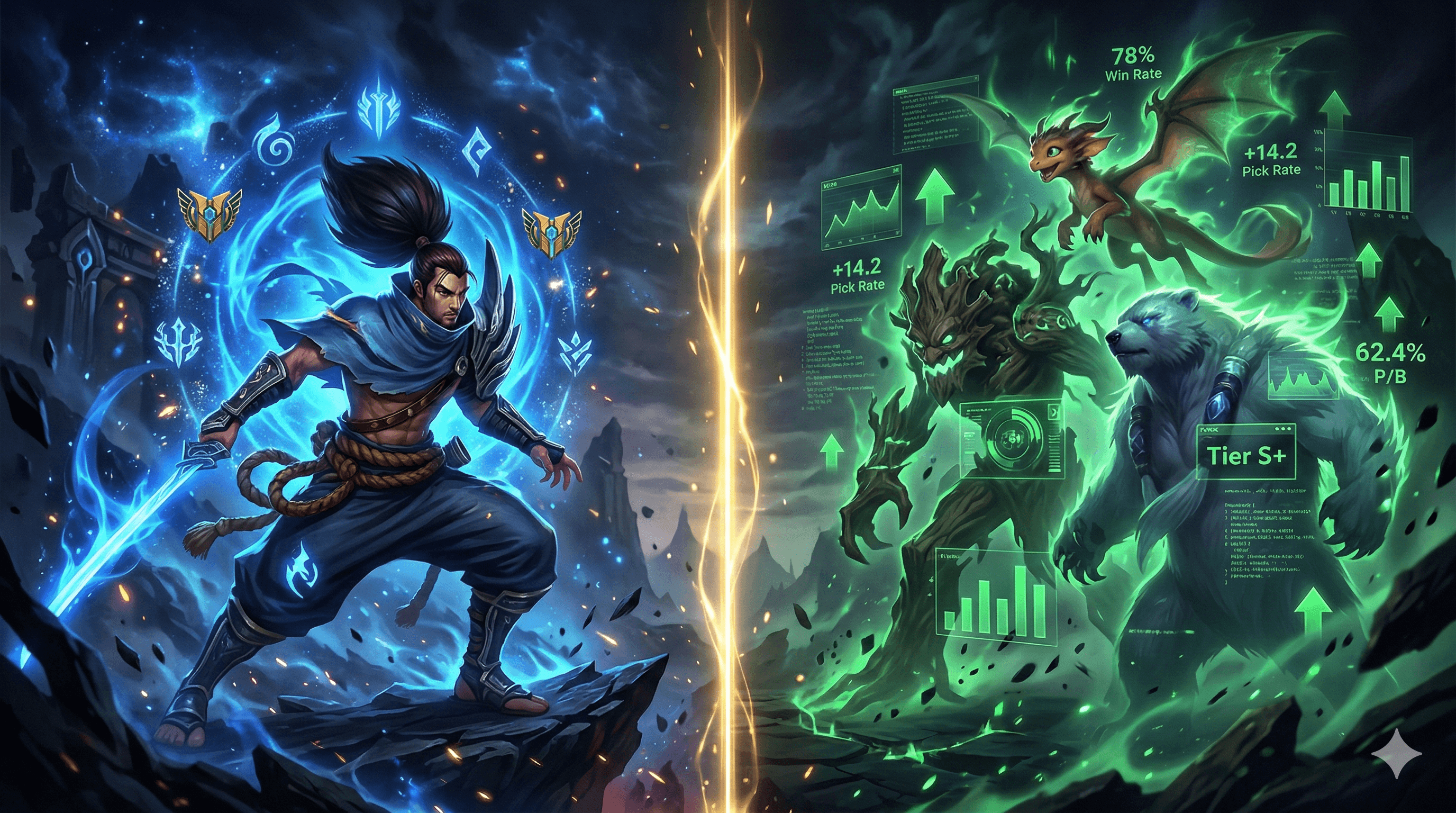
The Dilemma of the Century: Being an OTP (One-Trick Pony) or a “Meta Slave”? What the Data Says
Today we’re going to sit down and debate one of the hottest, most controversial, and most divisive topics in the entire League of Legends: Wild Rift community. It’s the kind of discussion that breaks friendships on Discord and fills Reddit threads every single day.
When you queue up for Solo Queue and seriously want to climb, you face a fundamental strategic decision: What is mathematically and strategically better for ranking up? Devote 1,000 games to a single champion regardless of team composition (be an OTP), or read patch notes religiously and only play what’s broken (be a Meta Slave)?
We’re not going to talk from superstition or bias. We’re going to break this dilemma down through player psychology, cognitive load theory, and what global high-elo win rate statistics actually show. Get comfortable, because we’re about to destroy a few myths.
1. Defining the Contenders: Which Side Are You On?
To stay on the same page, let’s clearly define these two player archetypes you see every day on the Rift. They’re like oil and water—two completely opposite philosophies.
The OTP (One-Trick Pony)
This is the romantic, stubborn, passionate player. The OTP picks one champion (let’s say Katarina, Riven, Yasuo, or Zed) and plays it in 99% of their games. Their in-game identity is that character.
They don’t care if their champion got four straight nerfs in the latest patch. They don’t care if the team desperately needs a tank, magic damage, or engage. They’ll blind pick their champion first rotation and try to brute-force carry through mechanics alone.
Their philosophy is bold and simple:
"I know my champion better than you know yours."
The Meta Slave
This is the analyst. The pragmatic, calculated, cold player. They have no emotional attachment to any champion from Runeterra’s lore. They don’t buy skins because tomorrow they might drop that champion entirely.
If the current patch buffs Smolder and Maokai beyond reasonable base stats, they’ll play Smolder and Maokai—even if they find them boring.
Their philosophy is purely results-driven:
"Why should I sweat trying to win with a weak champion that requires 300 APM when I can win by pressing two buttons on a statistically overtuned champion?"
Both approaches have passionate defenders. But in terms of pure efficiency for escaping ranks like Emerald or Diamond, there are hidden mechanics we need to understand.
2. Cognitive Load Theory (Or Why OTPs Look Like Macro Gods)
To understand why OTPs often climb fast in mid ranks, we need to talk about a fascinating psychological concept applied to competitive gaming: Cognitive Load.
Your brain works like a computer processor. It has limited bandwidth (RAM) to process real-time information. During a Wild Rift match, that bandwidth is split between two parallel processes:
-
Mechanics (Micro Play)
Landing abilities, dodging skillshots, executing combos in the optimal order, canceling animations, calculating lethal damage thresholds. -
Strategy (Macro Play)
Checking the minimap every five seconds, tracking the enemy jungler, timing Dragon and Baron spawns, managing waves, knowing when to group or split-push.
The OTP’s Invisible Advantage
When you play 500 games on Irelia, mechanics become muscle memory. You no longer consciously think:
- “What’s the exact range of my Q?”
- “Do I have enough damage to reset this dash?”
Your brain already knows.
By automating mechanics, the OTP frees up mental RAM to focus entirely on macro decisions. While the average player is sweating not to mess up their combo on a new champion, the OTP is tracking jungle pathing and planning a cross-map invade.
In short: OTPs win many games not because they’re mechanically unbeatable, but because automating mechanics gives them the mental space to make superior strategic decisions.
3. The Power of Numbers: Why Meta Slaves Dominate at the Top (Sovereign/Challenger)
If OTP is so effective, why don’t we see many pure OTPs in professional esports or in the highest ranks (Grandmaster and Sovereign)?
The answer is raw math, patch impact, and composition synergy.
Underneath the flashy graphics, Wild Rift is essentially a massive spreadsheet. If Riot increases a tank’s base armor by 10 and reduces ultimate cooldown by 15 seconds, that champion mathematically survives longer and provides more crowd control per fight.
You can’t outplay numbers forever.
At very high elo, OTP advantage fades. Why? Because everyone has exceptional mechanics. Muscle memory is no longer unique—it’s standard.
So if a Zed OTP faces a hyper-buffed meta mage with early defensive itemization, the OTP will often lose—not due to lack of skill, but because base stats and scaling are superior.
The Meta Slave’s Strategic Edge
- Draft Unpredictability: You can’t be target banned because they master the top 4–5 champions in their role.
- Structural Adaptability: If the team drafts four AD champions, they can pivot to AP or tank to balance the comp.
- Winning in Champion Select: A superior composition can win the game before minions spawn.
4. The Achilles’ Heel of Each Style
Neither approach is perfect.
The OTP’s Nightmare
- The Target Ban: If your one champion gets banned, your level may drop dramatically.
- Hard Counters: Some matchups are nearly unplayable by design.
- Patch Crisis: A heavy nerf can invalidate thousands of games of muscle memory.
The Meta Slave’s Trap
- First-Time in Ranked Syndrome: Picking a broken champion without mechanical mastery is LP suicide.
- Inflated Skill Illusion: Climbing due to overtuned stats can mask fundamental weaknesses. When nerfs hit, rank collapses.
5. The Data’s Verdict: The Optimal Champion Pool Rule
If both extremes are flawed, what’s the optimal solution?
High-elo data consistently points to one model:
The Restricted Champion Pool (Two-Trick or Three-Trick Model)
Your pool should look like this:
-
Your Main Champion
Your comfort pick. Muscle memory. Play it ~60% of games. Ideally high skill ceiling and historically stable in meta. -
Safe Backup (Blind Pick)
A reliable, utility-heavy champion when your main is banned or you pick early. -
Meta Counter Pick
A flexible answer to whatever is dominant in the current patch.
Why Three Champions Is Optimal
You maintain low cognitive load (deep mastery of only three champions) while retaining enough flexibility to:
- Avoid draft disasters.
- Survive target bans.
- Adapt to shifting metas.
Conclusion: Work Smart, Not Just Hard
If you only play Teemo top regardless of your team’s needs, you’re hitting the same wall repeatedly.
Pure OTP can get you to Diamond quickly—but it’s time-inefficient long term.
Pure Meta Slave requires constant patch study and mechanical retraining.
Build a small three-champion pool. Master their matchups. Use your freed mental bandwidth to improve macro.
The map doesn’t change. Dragon timers don’t change. Wave math doesn’t change. Master the entire chessboard—not just one piece.
Visual Recommendation: The Debate in Action
To close this analysis, here’s a brutal community debate showcasing this exact dilemma. You’ll see how a One-Trick performs under extreme high-elo pressure versus analytical meta players exploiting patch advantages.
If you’re considering restructuring your ranked strategy, this is mandatory viewing:
So, which side are you on? Loyal to your main until death regardless of nerfs, or selling your soul to the meta for extra MMR?
See you on the Rift.
Jorge Villamizar
Analyst & AI Coach
Passionate about data and competitive strategy in Wild Rift.
Related Articles
 Calendar / Patches
Wild Rift Calendar 2026: Patch Dates 7.1 to 7.3 and New Meta Predictions
Check the official dates for Wild Rift patches 7.1, 7.2, and 7.3 in 2026. We analyze meta predictions, new champions like Ivern, and the Shyvana rework.
 Technology and Analysis
The Victory Plan: How to Use Our AI Coaching Tool to Break the Meta
Stop playing on instinct. Discover how our draft analysis and AI tool can optimize your strategy and lead you to Sovereign with smart decisions.
 Technology and Analysis
The Future of Wild Rift: AI Coaching and Dynamic Builds
Artificial intelligence is revolutionizing the Wild Rift meta. Discover how smart coaching and dynamic builds can pull you out of Elo Hell and lead you to the top of the ladder.