
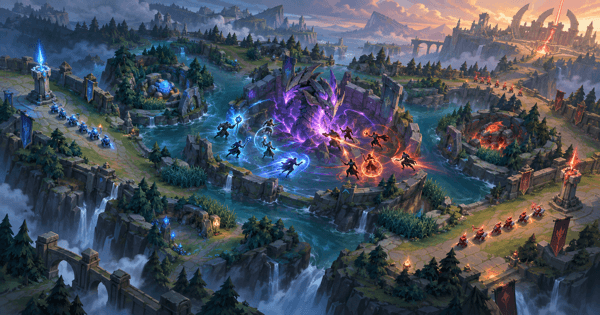
Wild Rift Patch 7.3 is scheduled for September 22, 2026 at 00:01 UTC. Riot can still adjust deployment timing, but this is the date currently listed on its official patch schedule.
More importantly, the preview already shows the shape of the patch: less stalled mid game, more punishment for ignored waves, more value in objective setup, and a Jungle that should reward preparation more than praying for one miracle Smite. Riot has confirmed two system-level directions for 7.3: a broad pass on Rift pacing and Jungle progression, plus another round of Ranked progression changes.
That distinction matters. Riot has shown the direction of the patch, but not every final number. Use this as prep, not as a finished tier list.
Quick answer: expect stronger wave pressure, a more deliberate path from towers and objectives into a win, a reworked Smite with persistent True Damage, tougher epic monsters, more stable Jungle progression, broader Ranked performance evaluation, a new Legendary S rating, role incentives, and Legendary Ranked progression updates. Exact balance numbers, champion changes, and item changes should wait for the final 7.3 notes.
Patch 7.3 release time
| Region / timezone | Scheduled release |
|---|---|
| Official Riot schedule | September 22, 2026 — 00:01 UTC |
Riot can still adjust deployment timing, but this is the current official release time.
If you are preparing to climb, keep playing the live meta until 7.3 actually lands. Once it does, watch how Jungle, waves, and objective fights feel in real ranked games.
Confirmed by Riot: match pacing is changing
Riot says recent matches can stall in the mid game and then end too abruptly around a powerful late-game objective. Patch 7.3 aims for a healthier tempo curve where advantages build through towers, wave control, and objectives, while defenders still have room to respond.
Minion pressure will matter more
Riot has confirmed that:
- Super minions will gain movement speed, defenses, and attack damage as more inhibitors are destroyed.
- Siege minions will reach their full structure damage earlier.
- Larger or stacked waves should create more meaningful map pressure.
- Towers, inhibitors, level leads, and Baron should help strengthen wave pressure without becoming automatic win conditions.
The key gameplay lesson is that a won fight should convert more naturally into something permanent. A team that wins an objective but ignores its waves may still waste the advantage.
Baron and Dragons should create steadier momentum
Riot also wants fights, towers, Dragons, Baron, and wave management to feel like one connected route toward victory.
Baron-empowered minions are intended to reach towers more reliably, giving teams a clearer siege window. Defenders will still be able to contest vision, clear unescorted waves, and punish bad siege positioning.
Dragon control is also meant to create more forward momentum before Elder Dragon appears, rewarding repeated early- and mid-game investment instead of concentrating too much value in one late objective.
Confirmed by Riot: Smite and Jungle progression are being reworked
Jungle is the most important system to watch on day one.
Riot says the role currently has high influence but can feel inconsistent because of uneven clear speeds, vulnerable camps, uneven income, and the pressure attached to a single Smite contest.
Smite gets a persistent True Damage burn
Patch 7.3 will rework Smite with a persistent burning True Damage effect that scales with the jungler's attributes.
Riot's stated goals are to:
- make objective control more reliable;
- reduce the feeling that one Smite moment decides the entire game;
- support progression paths for fighters, mages, and tanks;
- make objective setup, vision, positioning, and coordination more important.
Epic monsters will also receive increased resistances, which should make burst-combo steals harder and increase the value of proper setup.
Jungle economy and clear consistency are also targets
Riot says it is working to:
- equalize clear efficiency;
- improve baseline Jungle income;
- increase the cost for laners who take Jungle camps;
- make it less punishing for junglers to cover a teammate's lane.
What Riot has not published in these previews are the final live values behind those systems. We should not turn design intent into exact route recommendations until those numbers are available.
Confirmed by Riot: Ranked evaluation expands beyond KDA
Patch 7.3 also continues the Ranked Energy work introduced in 7.2.
Riot says the SA and MVP evaluation model will become more tailored to a player's lane, champion, and role. The system is intended to recognize contributions such as:
- vision impact and crowd control;
- objective participation, including Dragon control;
- pushing and coordinated team play;
- frontline damage absorption;
- supporting teammates and creating opportunities.
Kills and KDA still matter, but Riot explicitly says they will no longer define the entire evaluation.
Legendary S and role incentives
A new rating above S, Legendary S, will recognize exceptional performances and award additional Ranked Energy.
Riot is also adding Ranked Energy incentives for positions that need more players. Choosing Any Position and being autofilled will be treated differently, with autofill receiving the larger compensation. These bonuses will have weekly caps.
Legendary Ranked progression
Two additional changes are confirmed:
- Players who reached Grandmaster in regular Ranked in the previous season will have a lower entry threshold when returning to Legendary Ranked.
- The Legendary Commander tier gets a new promotion mechanic called Legendary Trial, which runs alongside normal Legendary Ranked progression and offers another promotion path during strong runs.
Probable meta impact: what could change first
Everything in this section is RiftForge analysis, not a confirmed Riot tier list.
1. Jungle may reward consistency over pure objective burst
If epic monsters become harder to burst and Smite distributes secure pressure over a burn window, objective control could shift toward teams that establish vision, zone entrances, and arrive first rather than compositions built around one instant steal combo.
That does not automatically make tank or mage junglers S tier. It means their clear speed, income curve, and objective execution deserve a fresh day-one test.
2. Wave management may become a bigger separator between teams
Stronger super and siege minion pressure can increase the value of timing recalls, setting side waves before objectives, and converting inhibitors into map control.
Players who win a fight and immediately chase kills may give up more value than before if the better play is to escort a stacked wave or force a structure.
3. Role-based Ranked scoring may change what “good performance” looks like
If the live system recognizes vision, frontline work, pushing, and objective participation more accurately, support, tank, and Jungle impact may be represented better than a KDA-first model.
The important caveat is that Riot has not published the exact scoring weights. Do not grief a winning play to farm “good-looking” stats.
What to watch when Patch 7.3 goes live
Before changing builds or tier lists blindly, watch these areas first:
- Champions: who actually wins or loses after the final notes.
- Items and runes: which builds change in real games, not just on paper.
- Jungle: routes, clear speed, income, and Dragon/Baron control.
- Waves: how hard towers, inhibitors, and side lanes punish sloppy macro.
- Ranked: whether the new evaluation better rewards vision, frontline, objectives, and map pressure.
You can already use the RiftForge match analyzer, review the champion tier list, or check the item tier list. Those pages should remain grounded in the current live patch until 7.3 data is verified.
What is still unknown
The two September 14 Riot articles are previews, not the complete 7.3 patch notes. As of this article, they do not provide the complete numerical balance package for champions and items.
So we are not publishing speculative champion winners, item winners, exact Jungle routes, or a fake “day-zero tier list.” Those can only be useful once the final notes and live behavior are available.
Bottom line
Patch 7.3 looks less like a patch about one overpowered champion and more like a patch about how Wild Rift rewards map control.
Riot is connecting waves, towers, Dragons, Baron, Jungle progression, Smite, and Ranked evaluation more tightly to the decisions that actually win games. If the live implementation matches the preview, fast climbers will be the players who understand why an advantage matters, not just who has the most kills.
The preview gives one clear assignment: when 7.3 lands, play ranked with map awareness. Do not only track damage and kills; watch who turns waves, objectives, and tempo into wins.
Official sources
RiftForge Team
Wild Rift meta analysis and coaching
RiftForge analyzes the systems, builds, and decisions that have the greatest impact on ranked Wild Rift matches.
Related Articles
 Champion Guide
Yunara Wild Rift Guide 7.2a: Build, Abilities and Transcendence
Learn how Yunara works, which build to use in Patch 7.2a, and how to turn her Transcendent windows into sustained damage without giving away the lane.
 Patch Notes
Wild Rift Patch 7.2: The Update That Breaks Your Old Builds
Wild Rift Patch 7.2 reshapes active items, boots, Ranked, and class identity. Here is what the new meta means and how to adapt your builds.
 Calendar / Patches
Wild Rift Calendar 2026: Patch Dates 7.1 to 7.3 and New Meta Predictions
Check the official dates for Wild Rift patches 7.1, 7.2, and 7.3 in 2026. We analyze meta predictions, new champions like Ivern, and the Shyvana rework.